The Real Torre Argentina
Contrary to popular belief, the small tower rising above the Sacred Area of Largo di Torre Argentina is not the tower that gave the square its name.
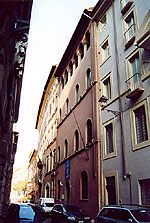
The real Torre Argentina, today incorporated into the Casa del Burcardo
The Origin of the Name
The real Torre Argentina is today incorporated into a sixteenth-century building in German-Gothic style, known as the Casa del Burcardo (Via del Sudario 44). In the 16th century this medieval structure was altered by Johannes Burckardt of Strasbourg (in Latin Argentoratum), the papal master of ceremonies.
It was from this Latin name for Strasbourg, Argentoratum, that the tower took its name "Argentina". Later, the name spread to the whole surrounding area, giving rise to the place-name "Largo di Torre Argentina".
The Casa del Burcardo is today home to the Burcardo Theatre Museum and Library, one of the most important collections of documents on the history of Italian theatre.
Did you know? Casa del Burcardo
Johannes Burckardt (Italianised as Giovanni Burcardo) served as papal master of ceremonies under five popes: Sixtus IV, Innocent VIII, Alexander VI (the famous Rodrigo Borgia), Pius III and Julius II. His diary, the "Liber Notarum", is an invaluable historical source that documents life at the papal court between 1483 and 1506, including the scandalous years of the Borgia pontificate.
The Two Towers: A Comparison
Torre Argentina
Origin of the name: From the Latin Argentoratum (Strasbourg), home town of Giovanni Burcardo
Period: Medieval, with 16th-century alterations
Location: Via del Sudario 44, incorporated into the Casa del Burcardo
Features: Medieval tower incorporated into a German-Gothic building
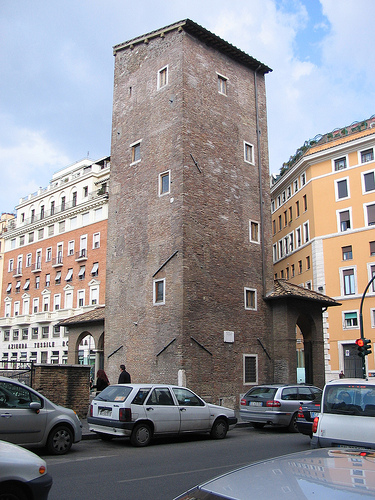
The Torre del Papito
Origin of the name: From the Papareschi family or from antipope Anacletus II Pierleoni
Period: Medieval (12th century)
Location: Largo di Torre Argentina, above the Sacred Area
Features: 17.5 m tall, restored in 1940 by Antonio Muñoz
The Torre del Papito
The tower that can be seen today in Largo di Torre Argentina, often mistaken for Torre Argentina, is in fact the Torre del Papito. Some 17.5 m high, it was part of a larger complex set on top of the Republican-era temples of the Sacred Area.
The epithet "del Papito" is thought to come either from the Papareschi family (also called "de Papa") or from the memory of antipope Anacletus II Pierleoni (1132–1138), a young, short-statured rival of Innocent II Papareschi – hence the diminutive "Papito". Anacletus II is also believed to have restored the church of San Nicola de Calcarario, no longer extant.
The tower was "freed" by the architect Antonio Muñoz in 1940 through the demolition of the buildings flanking two of its sides. During the restoration all the windows were altered in an attempt to restore the original look of the medieval structure.
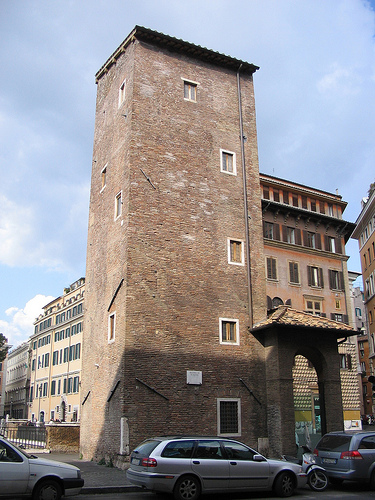
Detail of the Torre del Papito and the adjoining portico
The Small Portico
Next to the Torre del Papito a small portico survives, made up of granite and bigio-marble columns. This architectural feature belonged to a medieval building set on the remains of the Roman temples, probably connected with the church of San Nicola de Calcarario.
Historical Timeline of the Area
1st century BC
Building of the temples of the Sacred Area of Largo Argentina
12th century
Construction of the Torre del Papito and the church of San Nicola de Calcarario
16th century
Giovanni Burcardo alters his residence, which includes the tower that will be known as Torre Argentina
1926–1929
Archaeological excavations bring to light the Sacred Area of Largo Argentina
1940
Restoration of the Torre del Papito by the architect Antonio Muñoz
Today
Torre Argentina is home to the Burcardo Theatre Museum and Library, while the Torre del Papito is an integral part of the archaeological site of Largo Argentina
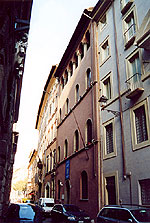
Entrance to the Burcardo Theatre Museum and Library
The Burcardo Museum
The Casa del Burcardo, which incorporates the real Torre Argentina, today houses the Burcardo Theatre Museum and Library, founded in 1932 and run by SIAE (Italian Society of Authors and Publishers).
The museum holds a vast collection of documents, manuscripts, sketches, costumes and memorabilia covering the history of Italian theatre from the 16th century to the present day. The library contains over 100,000 volumes, including rare editions of plays, scripts, opera librettos and specialised journals.
It is a key resource for scholars and theatre enthusiasts, who can consult rare and precious documents in a building that is itself a piece of Roman history.
Visiting information
Address: Via del Sudario, 44 - 00186 Roma
Hours: Monday–Friday, 9:30–15:30 (consultation by appointment)
Phone: +39 06 6819471
Email: biblioteca.burcardo@siae.it